03 / Portable goods / Follow the whole journey
Ways to Take Things
A carrying method is a small transport system. What matters is not only what fits inside, but how it travels, opens, returns and gets cleaned.
Begin at the destination
Imagine carrying lunch on a crowded bus, taking vegetables home on foot or presenting a wrapped parcel to a friend. Each trip asks different things of a container. A comfortable handle may matter more than compact storage. Separate compartments may be useful even when they do not seal against liquids. A wrap that folds flat on the way back may suit a load that never needs a rigid shell.
Japanese furoshiki, Indian tiffin carriers and baskets associated with Bolgatanga in Ghana illustrate three approaches. These objects have wider histories and present-day uses than a brief guide can contain. Here, their everyday mechanisms are the focus: adapting fabric, stacking vessels and carrying an open load.
Furoshiki: the container takes the shape of the load
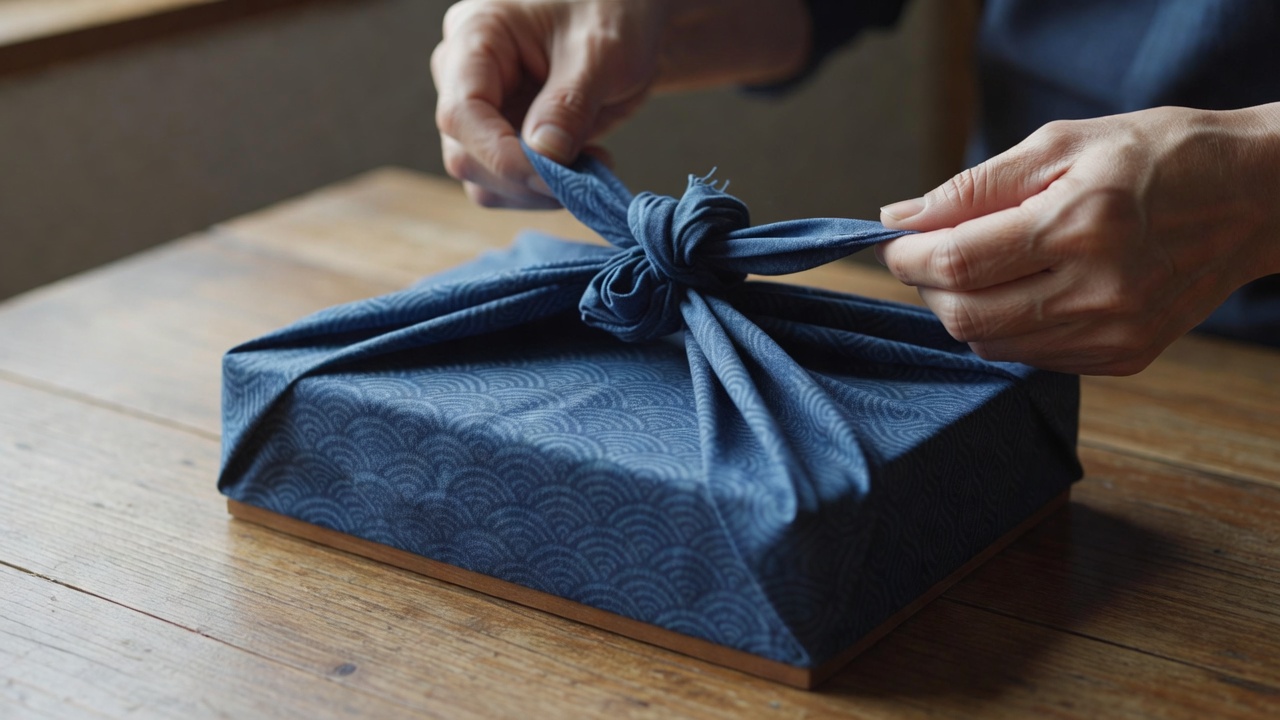
A furoshiki is a wrapping cloth associated with Japan. By folding and tying a square of fabric, a person can wrap a box, gather a bundle or create a temporary carrying arrangement. When it is empty, the cloth returns to a small, flat form rather than retaining the shape of a bag.
The result depends on the relationship between cloth and contents. A fabric that works around a light lunch box may be a poor choice for a heavy bottle. Smooth material can slip; an undersized square leaves too little fabric for secure knots. Practice with an unbreakable object over a low surface before trusting a new tying method with something fragile.
Wrapping is also part of an exchange. Do not assume the cloth is always a gift or always meant to be returned. Ask or explain your intention naturally. If you use an existing scarf, check its strength, cleanliness and care requirements rather than treating every square textile as equivalent carrying equipment.
Tiffin carriers: separate dishes, one handle
Stacked tiffin carriers combine several food containers in a frame or clasp arrangement. They can keep components of a meal apart while making the whole set portable. Stainless-steel versions are familiar in India and elsewhere, although materials, lids and fastening systems vary considerably.
Mumbai’s dabbawala lunch-delivery system is often used to illustrate the carrier in motion. It is important to distinguish the object from the organization: the reliability of that delivery practice depends on people, sorting and routes, not on a clever container alone. A tiffin bought elsewhere does not reproduce the surrounding service.
The common misunderstanding is that stacked means sealed. Some tiers simply rest together and will leak when tilted. Nor does metal construction imply insulation. Plan food temperature and travel time according to appropriate food-safety advice, and check whether the actual container has tested sealing or thermal features. Never put an ordinary metal tiffin into a microwave.
Look beyond capacity to washing. A clasp that is awkward to release or a lid that traps residue can make daily use frustrating. If you need to reheat lunch at work, consider whether you will transfer the food to another vessel.
Bolgatanga baskets: a structure for an open load
Baskets associated with Bolgatanga in northern Ghana are woven in varied forms and sold locally and internationally. A market-style basket can hold produce with a broad opening that makes loading and inspection easy. Unlike a soft bag, its body provides some shape even before it is filled.
Do not reduce the craft to a generic “African basket” label. Ask where a particular piece was made, which materials were used and whether the seller can explain the maker relationship. A regional name on a listing is not, by itself, evidence of origin, fair payment or a specific cooperative’s involvement.
Some sellers provide instructions for gently reshaping baskets that have been compressed for transport. Follow the guidance for the actual materials and handle construction, then dry the basket as directed. Do not assume a woven object is waterproof, suitable for prolonged damp storage or safe for unlimited weight.
Compare the journey, not the romance
Misconception
- A cloth wrap replaces every shopping bag.
- A metal lunch carrier keeps food safe indefinitely.
- A handmade label proves the maker was paid fairly.
Explanation
- Weight, weather and closure requirements still matter.
- Time, temperature and seal design need separate checks.
- Traceable sourcing is more useful than an evocative label.
| Format | Strength | Trade-off |
|---|---|---|
| Furoshiki | Adapts and folds flat | Needs suitable fabric and secure tying |
| Tiffin carrier | Separates meal components | Sealing and insulation vary |
| Woven basket | Structured, accessible opening | Bulky to store; often open to rain |
The most useful choice may be the thing already in your cupboard. Test your real route with a modest load, notice the uncomfortable or unreliable step, and solve that particular problem. An object deserves attention because it supports someone’s day, not because it can be advertised as a universal replacement.