01 / Food tools / Ingredients before equipment
Tools Around the Meal
Before asking what a kitchen tool does, ask what people are trying to cook, how they serve it and which steps they repeat.
The meal is the starting point
A cooking object rarely works alone. It belongs to an arrangement of ingredients, heat sources, timing and shared expectations. A press may save effort because the same dough is shaped many times. A pot may move directly to the table because the cooking and eating happen together. Looking only at the object misses this useful surrounding system.
These examples connect with practices in Mexico, Japan and Morocco, but none describes every kitchen in those places. People buy ready-made food, improvise with other equipment and adapt family recipes. The point is to understand why an object can fit a routine, not to decide what an “authentic” household must own.
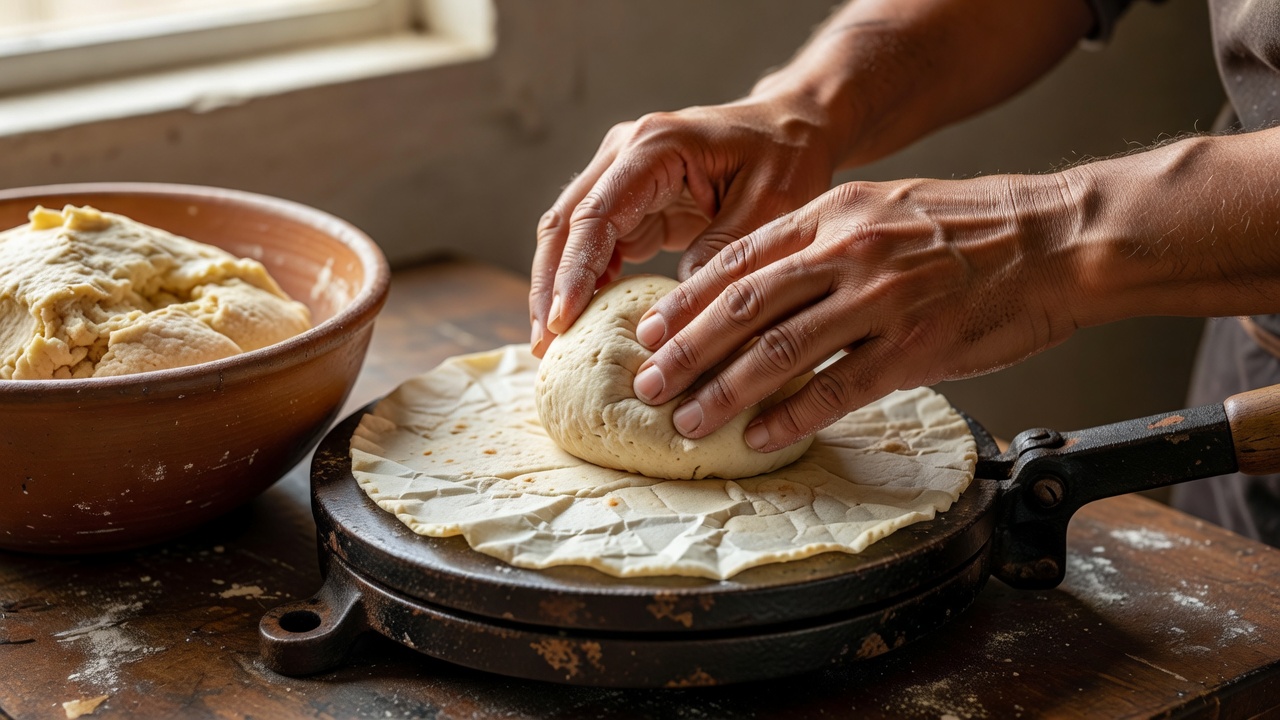
A tortilla press: repetition made manageable
When maize tortillas are made from masa, a hinged press can flatten a portion of dough quickly and fairly evenly. The cook usually places the dough between suitable liners, closes the plates and applies pressure through the handle. The tortilla is then transferred to a hot comal or another appropriate cooking surface.
The ingredient matters. Masa made from nixtamalized maize behaves differently from elastic wheat dough. A press advertised for every flatbread may not deliver the result you expect with a wheat-based recipe. In Oaxaca, as elsewhere in Mexico, maize preparations vary; a single tool does not erase differences in grain, thickness, size or technique.
For another kitchen, consider the plate diameter, handle clearance and weight before considering decorative details. A heavy press needs stable storage. Learn how the maker recommends cleaning its particular metal or coating, and do not force a handle to compensate for dough that is too stiff.
A donabe: a pot that joins the table
A donabe is a Japanese earthenware cooking pot. Depending on its design, it may be used for simmered dishes, rice or other preparations. In a shared hot-pot meal, the pot helps organize eating as a continuing activity: ingredients cook, portions are taken and the conversation carries on around them.
That social role does not make every donabe suitable for every heat source. Ordinary earthenware is not automatically induction-compatible. Some specialized products incorporate features for particular appliances, while others are intended for direct flame. Read the instructions for the exact pot rather than relying on the category name.
Avoid abrupt temperature changes and follow model-specific drying and seasoning guidance. A large pot can be appealing in a photograph but inconvenient for one person, a small sink or a crowded cupboard. Choose according to the meals you actually intend to repeat.
A tagine: matching the vessel to gentle cooking
“Tagine” can name both a dish and the vessel associated with it. In Moroccan cooking, the familiar shallow base and conical lid support slow, covered cooking. Moisture condenses inside the lid and returns towards the food, although the result still depends on ingredients, liquid, heat and the vessel itself.
The important distinction for a visitor is between cookware and serving ware. A beautifully painted piece may be intended only for presentation. Decorative appearance is not evidence of heat resistance or food-contact suitability. Ask the seller to identify the intended use and provide care information for the glaze and clay.
Some cooking tagines require a diffuser or particular preparation before use; others have different instructions. Do not assume that advice for one ceramic vessel transfers to another. If your hob and the maker’s guidance are incompatible, another covered pot may be the more practical way to learn the recipe.
Bring home a method, not just an object
A common assumption
- A traditional shape guarantees traditional performance.
- One version can handle every recipe.
- Buying the tool completes the skill.
A better explanation
- Materials and manufacturing determine safe use.
- Ingredients and appliances set practical limits.
- Repeated practice connects the tool to the meal.
| Tool | Routine it supports | Check first |
|---|---|---|
| Tortilla press | Repeated shaping of suitable dough | Recipe, size and stable storage |
| Donabe | Gentle cooking and, in some meals, shared serving | Heat-source compatibility |
| Tagine | Slow, covered cooking | Cookware versus serving-only status |
Buying from a maker or a well-informed specialist can make these questions easier to answer, but a compelling story is not a substitute for instructions. Ask what the product does, how it is maintained and what should never be done with it. Respect for a cooking tradition includes taking its practical details seriously.